

Stopping is a brief halt to allow people to get in or out or to load and unload. Anything that takes longer is parking. The most well-known rules are the 5-meter rule at pedestrian crossings and intersections, and the 20-meter rule at traffic lights and signs.
The difference between stopping and parking
The 5-meter rule
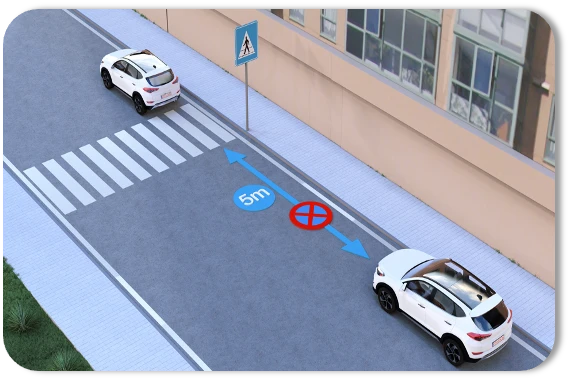
You may not stop or park on a pedestrian crossing or bicycle crossing, nor on the roadway up to 5 meters before it. Behind the crossing, you may stop directly adjacent. The same 5 meters applies at intersections: you must keep at least 5 meters away from the corner, so that visibility for other traffic remains clear. This prohibition applies to both stopping and parking.
The 20-meter rule
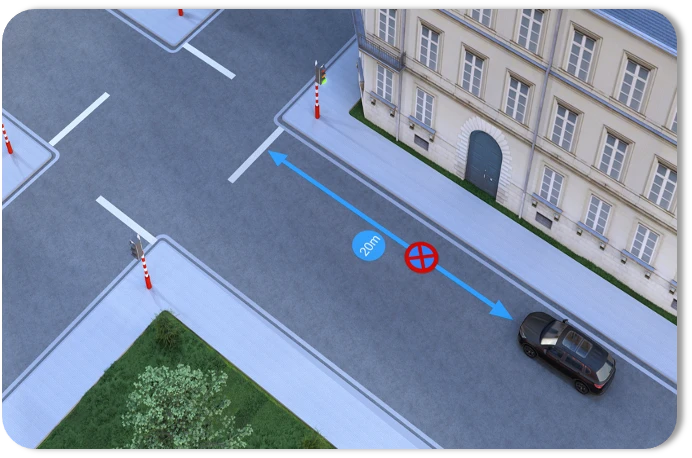
You must keep at least 20 meters away from traffic lights and traffic signs when your vehicle could obstruct visibility of them. You may park closer if two conditions are met: the bottom of the sign or light is at least 2 meters above the roadway, and your vehicle, including any load, is lower than 1.65 meters.
Where may you never stop or park?
- On sidewalks, bicycle paths, and bicycle crossings.
- On motorways and expressways.
- Double parked next to another vehicle on the roadway.
- On a checkerboard marking on the road surface.
Where is there only a parking prohibition?
In the following places, you may not park, but you may stop briefly to load or unload:
- In front of a driveway or garage door, unless your own license plate is mentioned on the door.
- Along a yellow broken line at the edge of the road.
- When the free passage on the roadway becomes narrower than 3 meters as a result.
Bicycle suggestion lane and bicycle zone
In a bicycle suggestion lane (the colored lane without the blue bicycle path sign) and within a bicycle zone, you may generally stop and park, as long as you do not obstruct traffic flow and there are no prohibition signs E1 or E3 present.
The signs E1 and E3
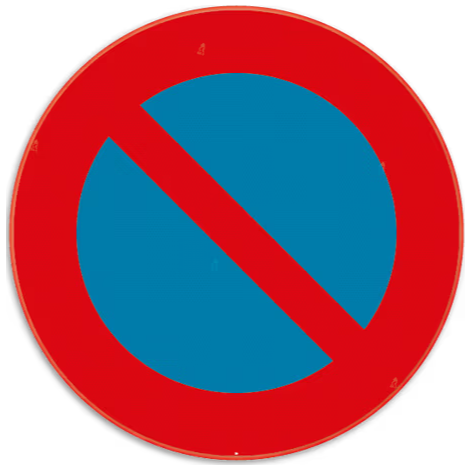
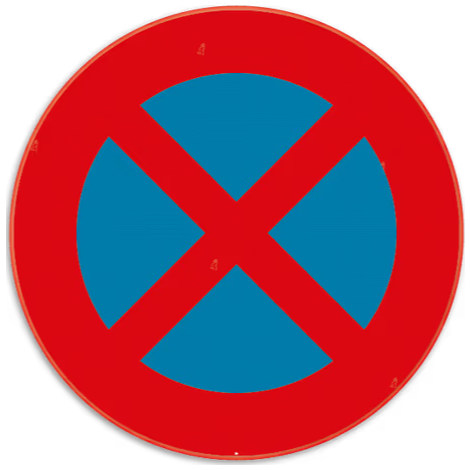
Sign E1 means parking prohibition, sign E3 means stopping and parking prohibition. They apply on the side of the road where they are located, up to the next intersection, and both on the roadway and on the shoulder.
The white supplementary signs with arrows clarify the zone:
- Arrow up: the prohibition begins from this sign.
- Arrow down: the prohibition ends just before this sign.
- Arrow in both directions: the prohibition continues (a repetition).
Frequently Asked Questions
At least 5 meters before it. After the pedestrian crossing, you may park directly adjacent.
Stopping is briefly halting to get in or out or to load and unload. If it takes longer, you are parking.
Yes, that is allowed, as long as you do not obstruct anyone and there is no prohibition sign.
Ensure you know all parking rules and distances?
With clear diagrams and the handy app, you can learn and practice whenever and wherever you want. Avoid extra costs and retakes with good preparation.
Choose your packageFurther reading: Traffic Signs · Priority Rules · All Traffic Rules
Last updated: June 2026 · Content reviewed by Mathieu, instructor · Source: the Belgian Highway Code