

In a traffic jam, there are two obligations that often appear on the exam: you create an emergency lane for emergency services, and at a road narrowing, you merge. Both apply as soon as traffic slows down significantly, so do not wait until you hear a siren.
The Emergency Lane: Create It Immediately
Creating an emergency lane is mandatory on all roads with at least two lanes in your direction as soon as a traffic jam occurs. This applies even within the built-up area, and even if no emergency service is in sight yet.
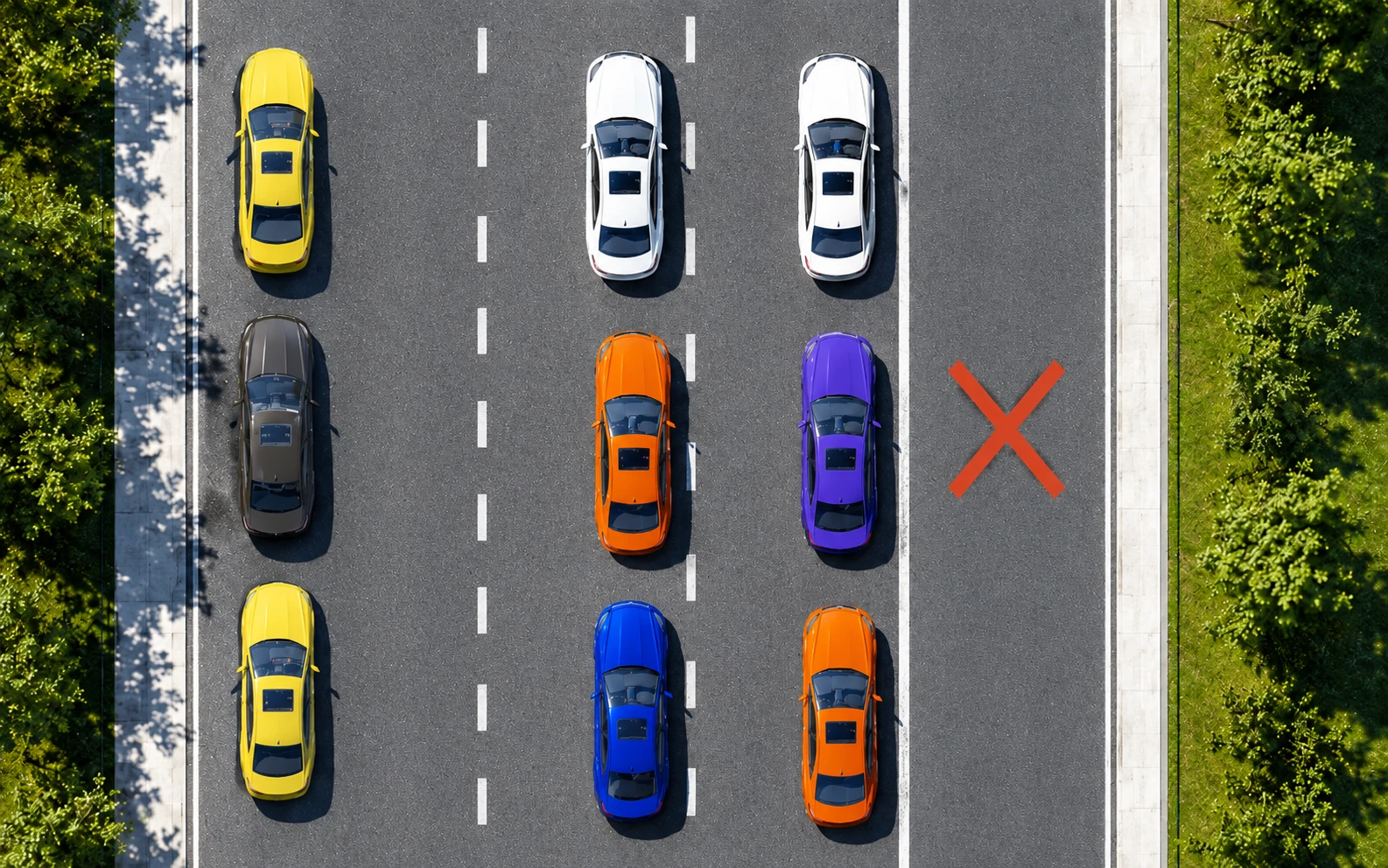
- Drivers in the left lane move as far left as possible within their lane.
- Drivers in the other lanes (middle and right) move as far right as possible.
The hard shoulder, bus lane, and bicycle path must remain completely clear: you are not allowed to use them to create the emergency lane. Only in extreme emergencies, when an emergency vehicle approaches and there is truly not enough space, may you briefly move onto the hard shoulder.
Motorcyclists may use the emergency lane to pass at moderate speed (maximum 50 km/h, with a speed difference of at most 20 km/h). However, as soon as an emergency vehicle or tow truck approaches, the motorcyclist must also immediately move to the side.
Merging at a Road Narrowing
Merging is mandatory in significantly slowed traffic when a lane is closing. You drive up to just before the narrowing, and the continuing lane then allows one vehicle to merge at a time (the principle one for one). If traffic is flowing smoothly, the merging obligation does not apply. You can read the full explanation in merging in Belgium.
From 3 Lanes to 1
If the left and right lanes are closed and only the middle lane remains open, the driver in the middle first allows one car from the right to merge, then one from the left, and only then does he proceed himself.
You Do Not Merge on the Highway Entrance
On the entrance ramp (merging lane) of a highway, the merging obligation does not apply. An entrance ramp is an access road with a priority sign B1 (inverted triangle): you must yield to traffic already on the highway.
Frequently Asked Questions
As soon as a traffic jam occurs on a road with at least two lanes in the same direction, even if you do not yet hear a siren.
No, it must remain clear for, among others, tow trucks. You move within your own lane.
Between the left lane (furthest left) and all other lanes (furthest right).
Pass the tricky questions about merging and the emergency lane
These are relatively new laws where many candidates struggle. Practice them until they become second nature with the theory exams from eTheory.
Choose your packageFurther reading: Merging in Belgium · Right of way rules · Speed rules
Last updated: June 2026 · Content reviewed by Mathieu, instructor · Source: the Belgian Highway Code